
For the 15-20% of people worldwide who are neurodivergent and/or have physical disabilities, the frustration of navigating workplaces, schools, city streets, and other spaces is all too familiar. Most people take these environments for granted, yet people with disabilities often encounter sensory overload, disorientation, and barriers to physical mobility. This raises a simple, yet fundamental question: What if all offices, public spaces, websites, and products were designed to accommodate people of all needs and abilities?
Enter universal design (UD), a simple yet radical concept that, decades after it was introduced, continues to reshape what accessibility means in the workplace. In essence, universal design strives to make products, public spaces, technology, and even educational programs fully usable for everyone, to the greatest possible extent. It’s a design philosophy that has already been successfully implemented by a slew of major companies, including Microsoft, Apple, Nike, Procter and Gamble, and Starbucks.
Introduced in the mid-1980s by American architect Ron Mace, universal design revolves around 7 core principles:
1. Equitable Use
Provides the same means of use for all users, encouraging inclusion and reducing stigma.
- Example: A gently sloped entrance (used by everyone), as opposed to a ramp and stairs, which segregate users
2. Flexibility in Use
Accommodates everyone by offering choices for users.
- Example: Adjustable desks
3. Simple and Intuitive Use
Avoids complexity, instead ensuring all users can understand how to use or operate.
- Example: Pictograms in place of written information
4. Perceptible Information
Allows all users to access information, regardless of ability, experience, or literacy.
- Example: A “talking” microwave (appliance with tactile, auditory, and visual controls/feedback)
5. Tolerance for Error
Minimizes hazards and the consequences of mistakes.
- Example: A door that shuts slowly
6. Low Physical Effort
Requires little effort to use.
- Example: A lamp that can be turned on by just a touch (rather than twisting a knob)
7. Size and Space for Approach and Use
Provides easily navigable space and allows all users to reach and manipulate objects.
- Example: Countertops of varying heights
Moving Beyond Disclosure and Accommodations
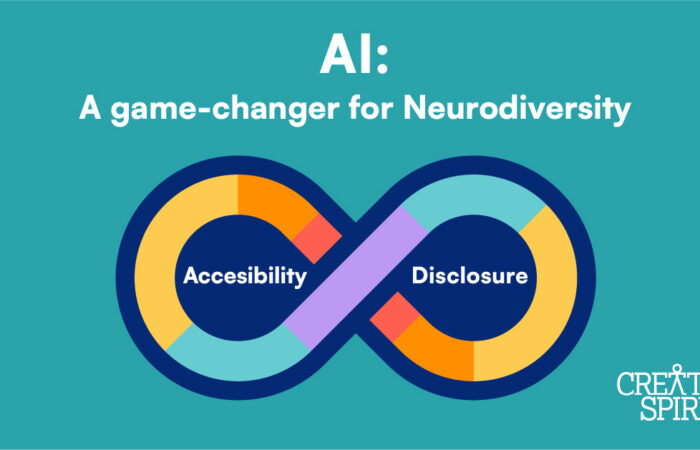
The importance of creating workplaces where neurodivergent employees are provided with reasonable accommodations and where they feel secure and comfortable with disclosure can’t be overstated. The business case for providing these accommodations is extremely compelling. Psychology Today writes that out of the organizations that have implemented practical neuroinclusion strategies, 63% see improvements in well-being, 55% in culture, 53% in management, and 45% in innovation. Universal design has the potential to go beyond disclosure and accommodations to create something much more substantive and impactful, creating workplaces with much greater retention and growth.
In their study “Moving Beyond Disclosure: Rethinking Universal Support for Neurodivergent Employees”, professors Hanna Kalmanovich-Cohen and Steven J. Stanton present a holistic approach to universal design that encompasses the entire employee lifecycle (hiring, onboarding, and management). Cohen and Stanton advocate what they describe as “a balanced approach—one that reduces reliance on disclosure by implementing universal support, while also fostering a culture that makes voluntary disclosure safe.” Perhaps most importantly, they write that, rather than support needing to be triggered by neurodivergent employees disclosing, universal design can make accessibility built-in to workplaces by default. The authors point out that practices such as offering flexible work hours, quiet spaces, job-sharing options, and noise-canceling headphones “accommodate a wide range of work preferences and cognitive needs without requiring individuals to disclose their neurotype.”
Going further, Cohen and Stanton suggest that many common needs can be met through universal support, without disclosure even being needed. They write that framing disclosure as voluntary reduces pressure and makes employees feel more comfortable with disclosure when more personalized assistance is needed beyond what universal support can provide. Using inclusive language in job materials, offering varied interview formats, and clearly communicating assessment expectations to all candidates, and creating flexible, strength-based career development opportunities are just a few of the possibilities in how universal and inclusive design can be implemented in the workplace.
Universal vs. Inclusive Design
In a video for IXDF.org, Kate Suetterlin, a UX content strategist and architect, acknowledges that creating true universal accessibility, or one accessibility solution, for billions of people isn’t really realistic. That’s where inclusive design comes in, creating multiple ways to meet people’s differences, rather than a one-size-fits-all approach. Suetterlin frames universal design as “battling” against inclusive design in that “if you think of everyone, you think of no one.”
In their article on universal design, IXDF outlines practical, actionable steps that companies and developers can take to incorporate Universal Design principles into their work. These include:
1. Conducting user research, involving individuals from different backgrounds, abilities, and cultures; defining inclusive personas
2. Defining inclusive personas, or creating personas that represent a diverse range of users, factoring in age, ability, gender, race, ethnicity, and language preferences
3. Prioritizing accessibility by following the Web Content Accessibility Guidelines (WCAG). This entails providing alt-text for multimedia content; ensuring assistive technologies can use your design; ensuring proper color contrast; using clear and concise language to communicate necessary information; and designing for keyboard accessibility.
4. Designing for flexibility and adaptability by creating an interface that accommodates different user preferences and abilities (i.e. adjustable font sizes, customizable color themes, and multiple navigation options)
5. Continuously gather feedback, make improvements based on user insights, and evaluate the effectiveness of your design.
Going Beyond the Business Case for Universal Design
As solid as the business case for neurodiverse hiring is, some experts believe universal design can offer an even more substantive approach. In their study “Beyond the Business Case: Universally Designing the Workplace for Neurodiversity and Inclusion”, researchers Elisabeth Silver, Mikki Hebl, and Christy Nittrouer write that universal design can move beyond the limitations of the business case for neurodiversity, such as the risk that performance gains won’t emerge as a result of neurodiversity, that neurodivergent employees would react negatively to financially-based justifications, or that they could be marginalized/commodified by treating neurodivergence as a “superpower”. The researchers believe universal design can enable neurodivergent employees to reach their full potential while avoiding the problems mentioned above.
“Incorporating UD principles into the workplace can create environments that allow neurodiverse and non-neurodiverse people alike to reach their full potential at work,” they write. “For instance, establishing dedicated quiet spaces and limiting strong smells (e.g., food, perfume) in office spaces
could mitigate attentional and sensory sensitivities sometimes experienced by people with ADHD and autistic people (DCEG Staff, 2022).”
One of the strongest arguments in favor of Universal Design is that it enhances the entire employment pipeline, adding clearer job descriptions and more flexible interviews, skills-based assessments, multiple learning formats, and more flexibility and sensory considerations to daily work. Through applying Universal Design, neurodivergent inclusion can become the default state, rather than something conditional or tacked-on for good measure. Making workplaces more accessible and inclusive reduces stress, burnout, and anxiety for neurodivergent employees, which in turn improves retention and enables them to deliver their best work. Companies can implement universal design not just in scheduling and in the design of workspaces, but on a technological level through text-to-speech, adjustable display settings, dictation, voice notes, and much more.
It’s just as important to point out that implementing universal design doesn’t have to be expensive or time-consuming. In her article for Regier Education.com, Patricia Regier writes that universal design accommodations can be as simple as making slides, documents, and videos accessible by default, allowing time for reflection and reprocessing, and using inclusive language in examples and learning content. “Creating Grace, Space, and Safe environments that include neurodiversity isn’t just an act of compassion,” Regier writes. “It’s a strategic advantage. When we design with universal inclusion in mind, we open the door for more creativity, innovation, and belonging.” All three of the above are indispensable for companies, creatively and financially, as universal design can help with reducing long-term costs and gaining a vital competitive advantage.
At a time when many workplaces are still uncertain about what inclusion really means, the 7 core principles of universal design offer a viable framework not just for the future of neurodiverse employment, but for healthier and more accommodating workplaces. Imagine workplaces that support cognitive diversity not just as an add-on, but through their very design, where all employees feel appreciated and confident enough to share creative input that could elevate the entire organization. Universal design brings all of that and more to the table, and it’s something every company, regardless of size or background, can and should capitalize on today.
Sources:
Kalmanovich-Cohen, Hanna, and Steven J. Stanton. “Moving Beyond Disclosure: Rethinking Universal Support for Neurodivergent Employees.” Frontiers in Psychology, vol. 16, 2025 www.frontiersin.org/journals/psychology/articles/10.3389/fpsyg.2025.1547877/
“Universal Design.” Interaction Design Foundation (IxDF), ixdf.org/literature/topics/universal-design
Regier, Patricia. “Neurodiversity, Brains, and Universal Inclusion.” Regier Education Inc., www.regiereducation.com/neurodiversity-brains
Silver, Elisabeth, Mikki Hebl, and Christy Nittrouer. “Beyond the Business Case: Universally Designing the Workplace for Neurodiversity and Inclusion.” Equality, Diversity and Inclusion: An International Journal, vol. 43, no. 1, 2024, pp. 154–170. ResearchGate