

Every parent of a neurodivergent child knows a truth we rarely say out loud: it’s all hard.
School is hard. The IEP meetings, the calls from the principal, the homework battles at the kitchen table, the quiet worry about who your child will sit with at lunch. Life outside school is hard too. Friendships, haircuts, birthday parties, the grocery store on a loud Saturday. Each day asks for more patience than you knew you had.
When everything is hard, it is easy to lose the thread. You can spend years fighting each battle on its own terms and never get to ask the bigger question: what is all of this for?
For nearly ten years, Creative Spirit has answered that question with one word. Work.
Why a job is the lighthouse
A lighthouse does not calm the sea. It gives you something to steer toward. A job does the same for a family. When the goal is real work with a real paycheck, every hard thing along the way gains a purpose. Reading practice matters because jobs require reading. The social skills group matters because coworkers say good morning. Bus training matters because one day that bus goes to an office, a studio, or a warehouse.
And the destination is bigger than a paycheck. It is a life of dignity, where a young adult feels useful, feels proud, and earns a living wage. It is what every parent wants for every child.
Why the stakes are so high
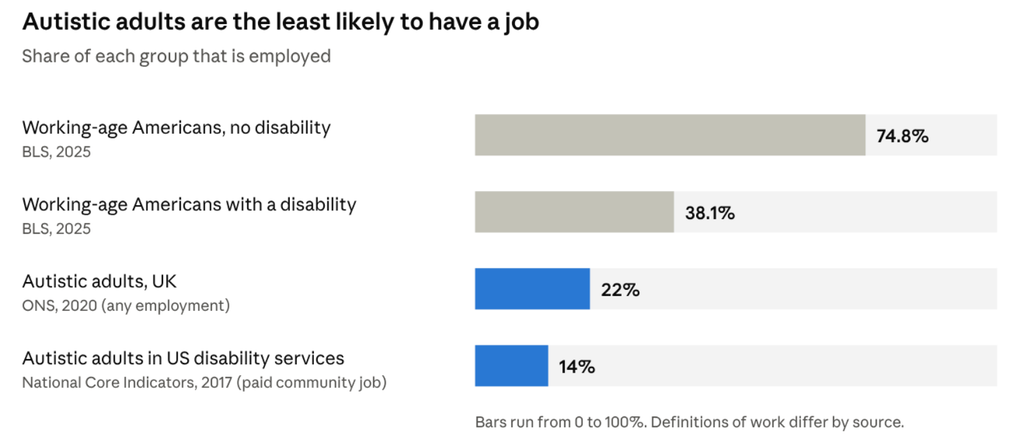
The numbers are sobering. In 2025, only 38 percent of working-age Americans with a disability had a job, compared with 75 percent of those without one. For autistic adults the picture is darker still. In the UK, which tracks this most closely, just 22 percent of autistic adults are in any kind of work, the lowest of any disability group. Here at home, only 14 percent of autistic adults receiving state disability services hold a paid job in their community.
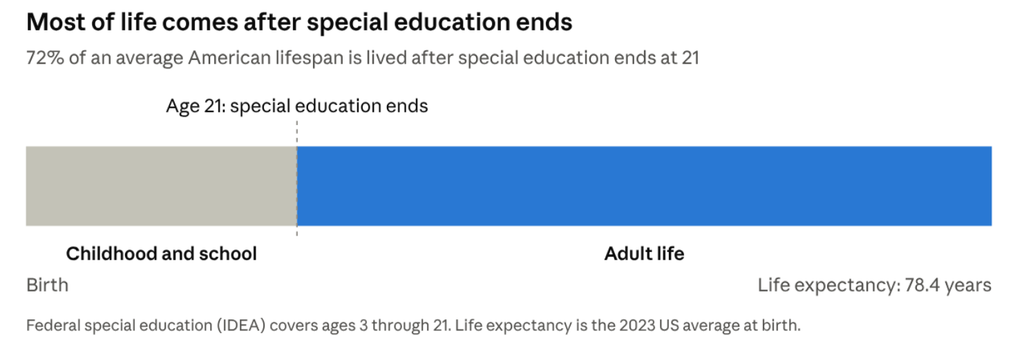
The calendar raises the stakes further. Federal special education ends at 21. Americans live, on average, to 78. That means about three-quarters of a life unfolds after the school bus stops coming. Without work, those decades can mean nothing to do, no money to spend, and no reason to get up in the morning. Researchers at Drexel University found that more than a third of autistic young adults had neither a job nor any further schooling in their early twenties.
Keep your eyes on the light
This is why Creative Spirit puts employment at the center of everything we do. Our coaching, our training for employers, and our work with hiring partners all point at the same light: a neurodivergent adult, at work, valued for what they bring.
So yes, it’s all hard. But hard with a purpose is a different thing entirely. Every IEP meeting, every patient morning, every small win is a stroke toward shore. Keep your eyes on the light. We will be there, holding it steady.
Sources
U.S. Bureau of Labor Statistics, Persons with a Disability: Labor Force Characteristics, 2025, March 3, 2026. Ages 16 to 64: 38.1% employed with a disability, 74.8% without. https://www.bls.gov/news.release/disabl.htm
National Autistic Society, New data on the autism employment gap, February 19, 2021, citing the Office for National Statistics, Outcomes for disabled people in the UK: 2020. https://www.autism.org.uk/what-we-do/news/new-data-on-the-autism-employment-gap
A.J. Drexel Autism Institute, National Autism Indicators Report: Developmental Disability Services and Outcomes in Adulthood, May 2017. https://drexel.edu/news/archive/2017/may/national-autism-indicators-report-finds-low-employment-for-adults-with-autism-on-dd-services
A.J. Drexel Autism Institute, National Autism Indicators Report: Transition into Young Adulthood, April 2015. https://drexel.edu/news/archive/2015/April/Autism-Indicators-Young-Adult-Transition
U.S. Department of Education, IDEA regulations, Sec. 300.101. https://sites.ed.gov/idea/regs/b/b/300.101
CDC National Center for Health Statistics, Mortality in the United States, 2023. https://cdc.gov/nchs/products/databriefs/db521.htm