
Some of society’s biggest challenges – whether political, economic, or in education and employment – are too complex to be solved alone. This applies to one of the most urgent, but often overlooked problems: the 30 – 40% unemployment rate for the 50 – 66 million Americans who are neurodivergent. Many of these individuals are highly skilled, hard-working, talented, and qualified in a variety of fields, including marketing, science, data analytics, engineering, and more. Nevertheless, many companies are struggling with retention due to burnout from a lack of reasonable accommodations; vague, poorly-worded job descriptions; outdated hiring practices with rigid criteria that screens out neurodivergent jobseekers; and workplace cultures and systems that aren’t built for cognitive diversity.
Resolving this issue demands a robust employment network, or ecosystem, consisting of everyone from neurodivergent jobseekers and educators, to disability rights advocates, managers, and employers, all combining their resources, skills, and expertise. In this article, we’ll explore the strategies needed to maintain and develop that neurodiverse employment network; some of the organizations currently working to make a difference; and why nonprofits are uniquely equipped for the network-building process.
The Importance of Network-Building for Neurodiverse Employment
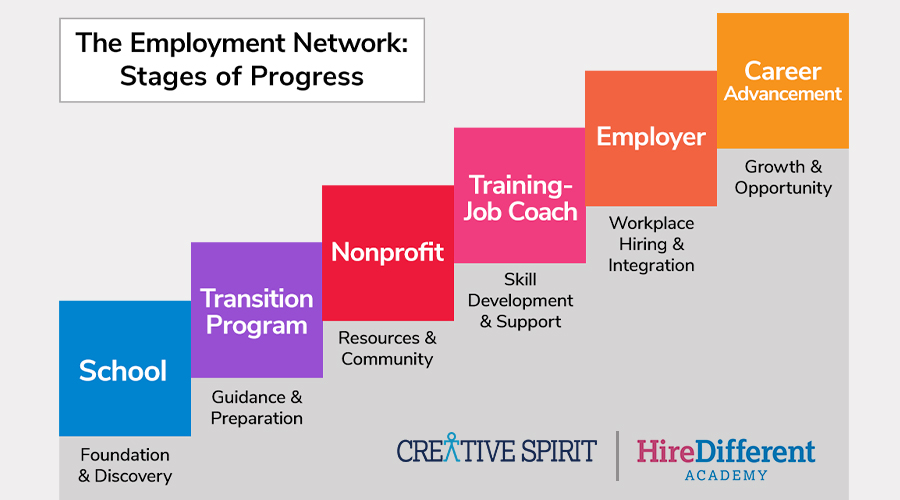
To fully appreciate why collaboration and networking are so important, the neurodiverse employment process can be viewed as a system of links. For example: school > transition program > nonprofit > training/job coach > employer > career advancement. If even one of these links is missing or dysfunctional, the whole process breaks down. Nonprofits, with their holistic support systems, focus on long-term outcomes, safe environments, and built-in trust with neurodivergent individuals, families, and advocacy groups, are uniquely equipped for network-building. These ecosystems are vital for neurodiverse employment for many reasons, including their ability to connect neurodivergent jobseekers with inclusive employers directly; avoid traditional networking barriers like sensory overload; and connect neurodivergent individuals with peers who share similar cognitive styles, avoiding the exhaustion or “masking”, or hiding being neurodivergent.
Since our founding in 2017, Creative Spirit has strived to build and sustain that employment ecosystem through our partnerships with a variety of organizations, along with job coaching, training, and mentorship for job seekers who are neurodivergent. On the employer side, we offer support through HireDifferent Academy (HDA), our comprehensive compliance, training, and certification program. Through HDA, we partner directly with companies of all backgrounds and sizes to help them create change for the better by rethinking their approach to hiring, appreciating cognitive diversity as a competitive advantage, and enhancing accessibility and inclusion in their workforce.
Organizations/Individuals Building the Neurodiverse Employment Ecosystem
Other companies and nonprofits are also starting to appreciate the link between network-building and fair-wage employment for the neurodivergent community. One example is the Neurodiversity Employment Network of Philadelphia (NENPHL), which brings organizations together for communication and partnership, along with sharing vital information about resources, organizations, and events. NENPHL’s most ambitious project is its Neurodiversity Ecosystem Mapping Tool, a living map that gives users insight into activity happening across NENPHL’s regional neuroinclusive employment network. The map also allows users to search by either Neuroinclusive Expertise or Employer Engagement to more easily identify potential partners, understand organization roles, and better understand how each organization contributes to pathways for employment.
As NENPHL’s website explains, the first category, “Neuroinclusive Expertise”, allows users to identify organizations by the specific services/programs they contribute to advancing neurodivergent employment. This includes higher education initiatives, postsecondary transition supports, workforce development, K-12 programming, and community-based services. Meanwhile, “Employer Engagement” provides insight into how companies are involved in inclusive employment where deeper involvement is possible, observable actions in awareness, retention, and hiring; helping employers understand next steps; and identifying individuals within the network that they can connect with to expand employment opportunities.
In addition to Creative Spirit and NENPHL, the Neurodiversity Employment Partnership (NEP), a group of organizations based in Massachusetts, demonstrates both the value and impact of network building. Disability:IN also contributes to neurodivergent network building through their Neurodiversity @ Work Employer Roundtable, which brings together employers and businesses of all sizes that are dedicated to hiring and supporting employees who are neurodivergent. Their connections include Deloitte, Charles Schwab, Google, Microsoft, and many others.
While NENPHL has strengthened neurodiverse employment through its living map, NEP is contributing through a partnership of job providers, educators, and organizations building skills for neurodivergent adults to use in the workplace. As NEP points out, between 50 – 85% of 5.6 million adults who are autistic/neurodivergent are either unemployed or underemployed, and only 22% report having paid employment, despite the fact that hundreds of thousands of jobs are available. The success of NENPHL and NEP in strengthening neurodivergent employment is proof of just how important collaboration and networking really are.
The “How” of Building a Neurodiverse Employment Network
We’ve shown the importance of network-building in ensuring fair-wage employment for people who are neurodivergent. However, some organizations might feel uncertain about how to get off the ground. Thankfully, there are a wide range of resources, strategies, insights, and toolkits available that can help guide you in the right direction.
In their article “Building Sustainable Communities Through Social Network Development”, network-building experts Valdis Krebs and June Holley note 5 general patterns that characterize all effective networks. These are:
- 1) Common attributes, goals, and governance
- 2) Diversity of connections
- 3) Several paths between nodes, ensuring that other pathways exist if several nodes are damaged or removed
- 4) A short average path length in the network, without forcing direct connections between every node
- 5) Some nodes are more prominent than others.
Krebs and Holley identify two of the most common pitfalls for networks as being 1) a lack of diversity, and 2) connections only with groups or individuals in close proximity.
“This [approach] results in many small and dense clusters with little or no diversity,” they explain. “Everyone in the cluster knows what everyone else knows and no one knows what is going on in other clusters.” They write that successful networks are actively managed, rather than being allowed to evolve without direction.
Krebs and Holley also pinpoint the 4 key phases of a vibrant community network. These are scattered emergence; single hub and spoke; multi-hub small-world network; and core/periphery. The first phase, “scattered emergence”, establishes an active leader, or “network weaver”, who takes responsibility for building the network, creating new interactions between different clusters. The second phase, “Hub and Spoke”, entails the “network weaver” bringing together diverse individuals and groups, and initiating a flow of information to and from them. Phase three involves the “network weaver” creating a “multi-hub small-world network”, meaning a complex system with high local clustering, short global path lengths, and multiple central connection points, or “hubs”, that organize the network into distinct regional/functional clusters. The last phase, the “Core/Periphery” network, represents the end-goal for sustainable community networks in the form of a stable structure that links well-developed networks in other regions. Improving fair-wage employment for the millions of Americans who are neurodivergent is vital for innovation and economic growth, especially at a time when 53% of Gen Z identifies as neurodivergent, and 20% of the U.S. workforce overall. According to research from Disability:IN, enhancing employment for neurodivergent individuals can increase the U.S. GDP by billions of dollars.
Along with organizations, some bold and creative individuals are also making a difference in network building and enhancing neurodivergent employment. One of those individuals is Tammy Harper, founder of CAI, a global technology services firm with an end-to-end neurodiversity employment program, along with being an active In her essay “How to Hire and Retain Neurodivergent Employees”, Harper advocates for changing the application and interview process, replacing it with a hands-on evaluation carried out by a team of learning and development (L&D) and neurodiversity certified professionals. “The evaluation process should offer a supportive environment that can last up to five days,” Harper writes. “During this time, and along with assessing the candidates’ hard skills, you will better understand soft skills, time management and workplace etiquette.” Harper also emphasizes the importance of not only providing reasonable accommodations, but personalizing the accommodations by getting to know the individual in question. “For those who struggle with anxiety, small and affordable solutions can make a profound impact,” she writes. “Rearview mirrors on their computers to see people walking behind, a small traffic light with each color indicating a certain mood level, or moving a desk away from a window or door with heavy foot traffic.” Harper’s perspective illustrates a critical point: that maintaining a neurodiverse employment network depends on building relationships, clear communication between employees and those supporting them, and understanding and respect on an individual level.
Summing Up
Building and maintaining a neurodiverse employment network might seem intimidating, but it is achievable with the right resources, hard work, and dedication, especially through the skills and connections provided by nonprofits. By defining a clear mission and goals in terms of what the network hopes to achieve; building flexible communication channels; working with employers to shift towards skill-based matching; gathering iterative feedback; and much more, nonprofits can have a huge impact in building those networks and transforming neurodivergent employment. Companies can also make a difference by connecting with local vocational rehabilitation agencies, autism societies, and disability support providers to create a robust talent pipeline; partnering with universities and community colleges to secure internship and early career pathways; and setting up an advisory council for businesses to share inclusion best practices and job openings. This coordinated, strategic, group effort can have a transformative impact on employment for the neurodivergent community. You can learn more about how to get involved and make that happen by partnering with Creative Spirit and HireDifferent Academy here.
Sources
Disability. “Neurodiversity Roundtable.” Disability, 2026, https://www.disabilityin.org/committees/neurodiversity-roundtable.
Harper, Tammy. “How to Hire and Retain Neurodivergent Employees.” Forbes, 22 Aug. 2022, https://www.forbes.com/councils/forbeshumanresourcescouncil/2022/08/22/how-to-hire-and-retain-neurodivergent-employees/.
Krebs, Valdis, and June Holley. “Building Sustainable Communities Through Social Network Development.” Nonprofit Quarterly, 21 Mar. 2004, https://nonprofitquarterly.org/building-sustainable-communities-through-social-network-development/.
Neurodiversity Employment Network of Philadelphia. “Neurodiversity Employment Network of Philadelphia.” Neurodiversity Employment Network of Philadelphia, https://neurodiversityemploymentnetwork.org/.
Neurodiversity Employment Partnership. “Neurodiversity Employment Partnership.” Neurodiversity Employment Partnership, https://nepemployment.org/.