
Over the past several decades, advances in technology have greatly improved accessibility and inclusion for the more than 50 million people in the U.S., and the approximately 1.6 billion people worldwide, who are neurodivergent. One of the most fascinating, less talked about ways in which technology is making a difference is through enhancing buyer/user personas, or fictional, research-based profiles/characters representing users with disabilities. Through AI Large Language Models (LLMs) like ChatGPT, Claude, Gemini, etc., these buyer/user personas (also called accessibility personas) allow companies to gain a more nuanced, in-depth understanding of customers who are neurodivergent. For those unfamiliar, LLMs are advanced AI trained on a large pool of data to understand and generate human-like text. Through LLMs, companies can create and interact with personas with customizable traits, helping them avoid misconceptions and stereotypes. LLMs can also be used to create marketing materials with high-contrast designs, clutter-free layouts, and reduced sensory overload, making them more accessible for customers who are neurodivergent.
While many companies acknowledge that AI holds enormous potential to improve neurodiverse inclusion, including in employment, they might be unsure about how to utilize it. In an essay for Clariant.com, Liza Park, a marketing associate for Clariant, explains her strategy for leveraging AI to help her company improve its buyer personas. Park writes that Clariant created a persona called “Resource-Challenged Rita”, meant to represent an experienced marketer lacking the internal resources to accomplish her goals. Park’s approach in using AI to improve and refine this persona can be applied to supporting individuals who are neurodivergent as well.
“AI isn’t magic,” Park points out in her essay. “It needs structure to turn data into gold. To make my process work, I had to prime my AI tool with rules and direction. Think of it like setting the groundwork for a painting; you need a rough sketch before laying down your colors.” By crafting specific prompts, Park was able to encourage the AI model to think about the strategy behind building buyer personas (i.e. questions like “what do you know about best practices for building an ideal customer profile?”, or “what are some commonly believed things about building ideal customer profiles that are believed to be true but are actually false?”). She also shared a Word document with the AI, explaining how Clariant has built its buyer personas. Her third step involved inputting the data and information about the “Rita” persona, along with the information gathered in Step 1 (such as transcripts from client interviews, along with using profiles from LinkedIn representing good-fit clients). “I treated the data input process like sculpting,” Park writes, “and I started chipping away at the rough edges of the original outputs by refining my prompts to be more specific about what I wanted, and then critically reviewing each new set of results.” Through this process, Park was able to evolve “Rita” from a vague sketch to a more relatable persona with depth and nuance.
One lesson Park learned from her efforts is that “good input equals great output”. In other words, more thoughtful and detailed data equals better results. She also found that AI is exceptionally good at recognizing connections between different data points, identifying patterns and insights that most people might not notice. “Before this project, I thought of AI as a time-saver,” Park writes, “a way to handle quick tasks. But I realized it’s much more than that. With the right approach, AI becomes a tool for uncovering clarity and depth in areas where I’d previously only scratched the surface.”
By using AI conscientiously, companies can enhance their understanding of neurodiversity, recognizing that neurodivergent individuals have diverse needs, personal stories, goals, and aspirations. A disability accessibility toolkit from the government of Canada also shares valuable insight into how buyer personas can incorporate accessibility needs for people who have disabilities and/or neurodivergence. They recommend emphasizing what abilities a person has, such as vision, hearing, mobility, dexterity, and cognitive abilities, rather than focusing on disability. The toolkit also recommends choosing from a wide range of adaptive technology, including screen readers, screen magnifiers, captions, and alternative pointers, such as a head mouse.
In addition to the insights of those in the business world, many people who are neurodivergent have weighed in on how AI has been life-changing as a source of empathy and a tool for improving organization and supporting social skills. One of those individuals is Kate D’hotman, a neurodivergent filmmaker based in Cape Town, South Africa. According to a Reuters report, D’hotman has been using ChatGPT since 2022 to overcome communication barriers at work and in her personal life. “I know it’s a machine,” D’hotman acknowledges, according to the report. “But sometimes, honestly, it’s the most empathetic voice in my life.” AI has also been beneficial for Sarah Rickwood, a project manager in the sales training industry. Rickwood, who has ADHD and autism, told Reuters that ChatGPT has allowed her to put together business cases and emails more clearly.
Some individuals with loved ones who are neurodivergent also told Reuters that AI has helped them improve communication and avoid misunderstandings. Michael Daniel, an Australia-based engineer and entrepreneur, created Neurotranslator, an AI-powered personal assistant. According to Reuters, the inspiration for the app came from Daniel’s need to communicate more clearly with his wife, who is neurotypical, after both he and his daughter were diagnosed with autism spectrum disorder (ASD). An app like Neurotranslator represents the potential of AI to act as a kind of empathy-building tool, serving as a force for good in the lives of people who are neurodivergent or have physical disabilities.
At the same time, acknowledging these benefits isn’t meant to downplay the risks in becoming overly dependent on AI, or in using it as a substitute for authentic human interaction and interpersonal relationships. Ethical concerns about biases programmed into AI models, potential privacy violations, and a lack of transparency in decision-making are all legitimate concerns. If anything, the fact that so many people who are neurodivergent are seemingly turning to AI for understanding, acceptance, and emotional support underscores the need for more of the same empathy to stem from actual human beings, rather than artificial intelligence. On a related note, companies should hear from people who are neurodivergent directly, rather than relying strictly on AI-based personas. That being said, using AI responsibly, including through buyer/user personas, is worthwhile for allowing companies to better understand and appreciate what neurodiversity actually means, improving validation and representation for a segment of the population that is often overlooked, despite being one of the world’s largest minority demographics. One of the clearest and most tangible benefits of this improved inclusion and representation would be its part in driving a cultural shift, where people who are neurodivergent feel more comfortable with disclosure, rather than “masking” or hiding being neurodivergent from coworkers and managers. Workplaces where neurodivergent employees feel secure, accepted, and comfortable will benefit from increased productivity, growth, and retention. In that sense, user/buyer personas can transcend mere marketing and consumerism, and they can help create a new paradigm for the neurodivergent community.
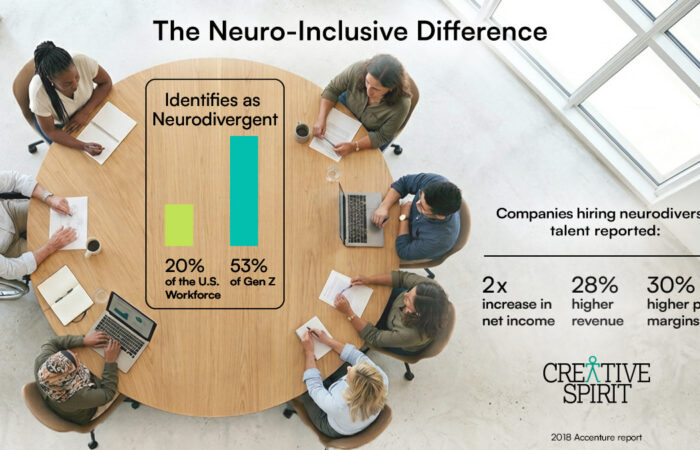
With the size of the neurodivergent community, advancements in technology making accommodation easier and more affordable, and the economic and societal benefits that come from neurodiverse representation, companies should be more incentivized than ever to make neurodivergent individuals part of their customer base and workforce. What starts with an artificial, AI-generated “persona” can and should transition into appreciating and including the “personas” of real-life people all over the world who think differently, and have amazing skills, talents, and capabilities to offer.
Sources
Park, L. (2025). How We Used AI To Improve Our Buyer Personas. Clariant Creative. https://www.clariantcreative.com/blog/how-ai-improved-our-buyer-personas
Richter, H. (2025). ‘It’s the most empathetic voice in my life’: How AI is transforming the lives of neurodivergent people. Reuters. https://www.reuters.com/lifestyle/its-most-empathetic-voice-my-life-how-ai-is-transforming-lives-neurodivergent-2025-07-26/
Accessibility Standards Canada. (2025). Personas with disabilities for inclusive user experience (UX) design. Government of Canada. https://a11y.canada.ca/en/personas-with-disabilities-for-inclusive-user-experience-ux-design/